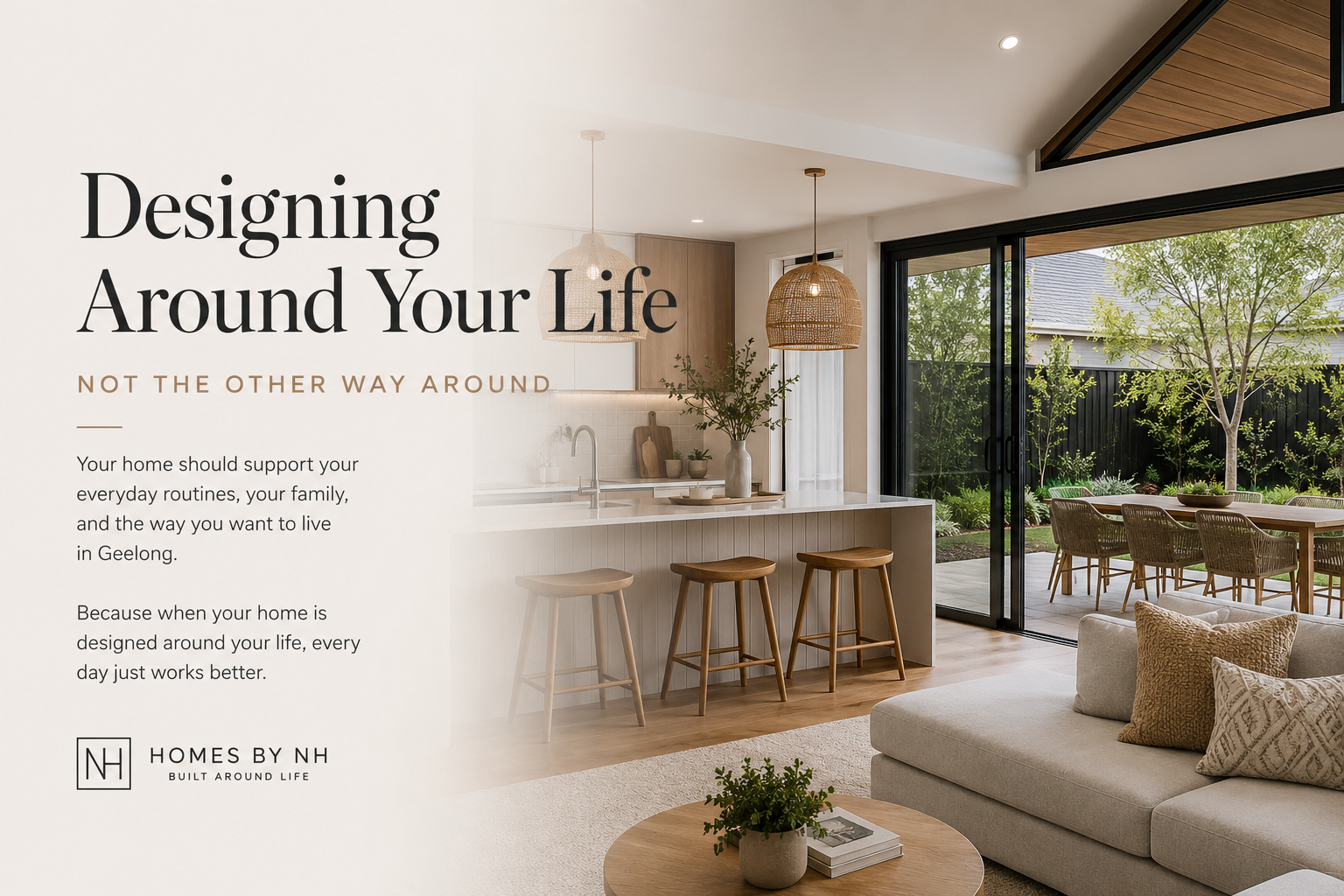
The right home should feel like it quietly supports your day, from your morning coffee to lights out, not the other way around.
Designing a new home is exciting, but it can also feel overwhelming. Floor plans, facades, room sizes, colours, budgets, and build timelines all compete for your attention. In the middle of it all, it is surprisingly easy to overlook one important question:
Does this home actually suit the way you live?
The most beautiful home on paper can become frustrating in reality if it works against your daily routines rather than supporting them. A great home isn't just attractive; it functions effortlessly, making everyday life easier, more comfortable, and more enjoyable.
At Homes By NH, we work with families across Geelong who aren't looking for a showpiece they are afraid to touch. They want a home that works for real life. A home where kids can run in after sport, the dog can race to the backyard, friends can gather comfortably, and quiet moments are easy to find when needed.
The best homes aren't designed around trends. They're designed around the people who live in them.
Start With Your Lifestyle, Not the Floor Plan
Most people begin their journey by browsing floor plans and pointing out what looks appealing. We prefer to start somewhere different.
Before discussing walls, windows, or room sizes, we focus on understanding how you actually live.
Some of the questions we ask include:
What does a typical weekday look like from morning to night?
Where does clutter naturally build up in your current home?
What frustrates you most about your existing layout?
Do you work from home occasionally or full-time?
How often do you entertain family and friends?
Where does everyone naturally gather at the end of the day?
When people answer honestly, clear patterns begin to emerge.
Maybe your mornings are rushed and you need a more efficient connection between the bedroom, bathroom, kitchen, and garage. Perhaps weekends revolve around outdoor entertaining, family gatherings, or spending time in the backyard. Maybe working from home requires a dedicated space that offers privacy without feeling disconnected from the rest of the house.
These insights become the foundation of a design that genuinely supports your lifestyle.
Zoning Your Home Around Real Life
A well-designed home is more than a collection of rooms. It is a series of spaces that work together naturally and intuitively.
One of the most effective ways to achieve this is through thoughtful zoning.
Public, Private, and Service Areas
We generally divide a home into three key zones:
Public Areas
Entry spaces, living rooms, dining areas, kitchens, and outdoor entertaining spaces. These are the areas where family and guests spend most of their time.
Private Areas
Bedrooms, studies, retreats, and quiet spaces where family members can relax and recharge.
Service Areas
Laundry rooms, pantries, mudrooms, garages, and storage spaces that keep daily life organised behind the scenes.
When these zones are positioned thoughtfully, the home feels calm and functional.
Guests aren't walking past bedrooms to reach the living area. Family members can enjoy privacy without feeling disconnected. Children can move from the backyard to the mudroom without tracking dirt through the entire house.
Good zoning isn't something most people notice immediately. They simply feel that the home works well.
That's often the sign of great design.
Getting the Kitchen and Living Areas Right
In most Geelong homes, the kitchen and living spaces are where daily life happens.
This is where family conversations take place, homework gets done, meals are prepared, and friends gather on weekends.
Because these spaces are used so frequently, their layout has a major impact on everyday comfort.
Consider questions such as:
How many people are usually in the kitchen at once?
Do you enjoy cooking while talking to guests?
Will children use the island bench for homework?
Do you entertain large groups or prefer smaller gatherings?
How important is the connection between indoor and outdoor spaces?
We encourage clients to think of the kitchen as a workspace rather than a showroom.
The right layout, storage solutions, appliance placement, and traffic flow can remove countless small frustrations from everyday life. A kitchen that functions well will continue adding value long after the excitement of new finishes has faded.
Similarly, a strong connection between the kitchen, dining area, living room, and outdoor entertaining space helps the home feel more connected and enjoyable to use.
Great design isn't about creating a magazine cover. It's about creating spaces that support the way you live every day.
Bedrooms, Retreats and the Need for Quiet
Life in Geelong can be busy. Between commuting, school runs, weekend sport, and social commitments, every home needs spaces where people can slow down and recharge.
One approach we often recommend is separating the main bedroom from secondary bedrooms, particularly for families with young children or teenagers. This gives parents a private retreat while allowing children to have their own zone for study, gaming, music, and everyday activities.
A few simple design decisions can make a significant difference:
Position bedroom doors away from major living areas to reduce noise transfer.
Create a small retreat or activity space near children's bedrooms so toys, games, and entertainment remain contained within their own zone.
Include generous storage from the beginning so clothes, books, school bags, and personal belongings have a dedicated place.
These details may seem small during the design stage, but they have a major impact on daily comfort. A well-planned layout should make life easier, not leave you tiptoeing around the house because bedrooms are positioned in the wrong place.
Work, Study and Flexible Spaces
The way Australians use their homes has changed significantly in recent years. More people now work remotely, operate businesses from home, or need dedicated spaces for study and personal projects.
Even if you don't work from home full-time, you may still benefit from:
A quiet space for video meetings and focused work
A study area where children can complete homework without distractions
A flexible room that can evolve from a home office into a nursery, guest room, hobby space, or teenager's retreat
We often position studies and multi-purpose rooms close to the main living area or near the home's entry. This allows them to feel connected to the rest of the house while still providing privacy when required.
Flexibility is equally important. Families grow, careers change, and lifestyles evolve. Designing spaces that can adapt over time often delivers far more value than creating rooms with a single fixed purpose.
A thoughtfully designed home should support not only the way you live today but also the way you may live five, ten, or twenty years from now.
Storage That Matches Real Habits
Every household has clutter hotspots.
Keys, shoes, school bags, sporting equipment, mail, pet supplies, and everyday essentials all need somewhere to go. Without proper storage, even the most beautiful home can quickly feel disorganised.
Some of the most effective storage solutions include:
A dedicated mudroom or drop zone near the garage or main entry
A generous walk-in pantry that keeps kitchen benchtops clear
Linen storage located close to bedrooms and bathrooms
Built-in wardrobes with practical shelving and hanging space
Well-planned bin storage that is accessible without being visible
Storage may never be the feature that sells a home in a display brochure, but it is often the feature homeowners appreciate most after move-in day.
Good storage reduces daily frustration and helps every room function the way it was intended.
Light, Orientation and Geelong's Climate
Designing a home in Geelong requires careful consideration of sunlight, prevailing breezes, seasonal weather, and site orientation.
Good orientation is about far more than energy efficiency. It influences comfort, mood, and the overall experience of living in the home.
We encourage homeowners to consider:
North-facing living areas where possible to maximise winter sunlight
Shaded outdoor spaces that remain comfortable during summer
Cross ventilation that captures natural breezes
Window placement that frames gardens, courtyards, and outdoor spaces
Natural light throughout key living areas
The way sunlight moves through a home can have a surprisingly powerful impact on everyday life. A bright kitchen in the morning or a living room filled with winter sunlight often contributes more to long-term satisfaction than expensive finishes ever will.
Outdoor Living That Feels Like a Natural Extension of the Home
In Geelong and the Bellarine region, outdoor living is part of everyday life.
Family barbecues, children playing in the backyard, pets roaming freely, and quiet afternoons in the sun all make outdoor spaces an important part of the home.
Rather than treating the alfresco area as an afterthought, we prefer to design it as a true extension of the main living zone.
This often means:
Positioning it close to the kitchen and dining areas
Providing enough space for both dining and relaxation
Including lighting and power where appropriate
Creating privacy from neighbouring properties
Ensuring easy movement between indoor and outdoor areas
When outdoor spaces are integrated properly, they become some of the most frequently used areas of the home.
What Makes a True Custom Home Builder in Geelong
Being a custom home builder in Geelong means far more than offering a selection of floor plans and upgrades.
For us, every project begins with understanding how our clients live.
We take the time to learn:
What works in their current home
What frustrates them every day
How they spend time together as a family
What they want their future lifestyle to look like
Those conversations guide decisions around layout, flow, storage, orientation, and functionality.
Some homeowners want a simple and efficient home that is easy to maintain. Others are seeking a more architecturally expressive design. Regardless of style, the principles remain the same.
A successful home should:
Support your current lifestyle
Adapt to future changes
Respond to Geelong's climate and conditions
Feel personal without becoming impractical
Our role is to translate your lifestyle into a home that feels natural to live in every day.
Bringing It All Together
One of the most valuable exercises during the design process is walking through a typical day before construction begins.
We often encourage clients to imagine:
Morning
Where do you wake up? How do you move through the house? Where are school bags, keys, and everyday essentials stored?
Daytime
If someone is working from home, where do they spend their time? How does natural light move through the space? How are household tasks managed?
Evening
Where does the family gather? Can different activities happen comfortably at the same time? Is there a balance between connection and privacy?
Night
How easily can parents check on children? Can someone move through the home without disturbing others?
Walking through these scenarios helps reveal small issues before they become expensive problems during construction.
The best homes are rarely the ones with the most features. They are the ones that quietly support everyday life, making routines easier, spaces more enjoyable, and family life more comfortable for years to come.
